Showing posts with label Able Spaceman 2020. Show all posts

31 December 2021

Scratchbuilt Celestial Bodies

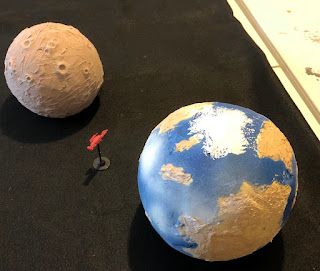
In anticipation of further playtesting of my solo spaceship miniatures game, I built a new planet and moon.

The celestial terrain was easy to build: Durham's Rock Hard Water Putty over a helium balloon for both spheres.  I started the moon first and made gores on paper using some geometric shorthand.  I smoothed the gores over the balloon and then covered with a thin water-putty coat.  

The planet originally started as an experiment to see if I could make a sphere using only the balloon as a former with no underlying gores.  Although it used more water putty than the gore method, it worked better than expected and was easier to get a smoother surface.


I only needed to wait maybe four hours before I could deflate the balloons in each sphere.  I then reinforced the interior of each very thin shell with water putty sausages as longitudinal ribs.  Finally, I poured a very very generous amount of wood glue into each sphere and let it cure overnight.  The reinforcing worked well: I actually dropped the moon from a height of about two feet and it didn't even chip.
    
Vacation is nearly over and I did only a fraction of the gaming I wanted to do.  Roleplaying consumed most of my free time during the break, or rather prepping for roleplaying did.  I finally got to run the Marvel Super Heroes Adventure Game (MSHAG), the SAGA system or "the one with the cards", for the first time in 22 years.  Even better, we're playing using my custom cards.  

The first RPG session was a blast but the second session was postponed after one of the two players cancelled, with the next session questionable due to the same player's new job.  Due to my impending school and work commitments, the Marvel game was supposed to be a three-shot event but now I'm wondering if we'll ever get past that first session.


I am amazed at how much time and effort it takes to do good Game Master prep (or maybe I over-prep).  And I lament all the other hobby time lost to the RPG prep, especially when it never gets used.  

So, we see a trend developing here... I said nearly these exact same words last year around the same time.  And like then, I'm planning to pivot away from RPGs and back to tabletop wargaming.  Wargaming solo works, for me at least, much better than solo RPGing, and with everybody's busy lives that seems to be the only version of Game Mastering I'll get. 

I'm not doing a year end retrospective or laying out my plans for the new year.  Frankly with my work and school schedule, free time will be depressingly scarce.  I will endeavor to post more frequently though.  2021 was my best year in a while and I'm hoping to make 2022 even more blog-prolific.
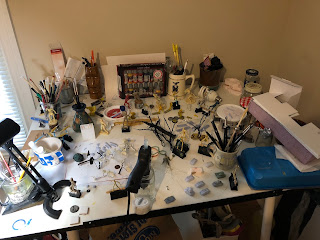
Just embarrassing...

I posted at the beginning of 2021 some rules I tried to self-enforce, to keep my gaming sustainable and focused.  One rule was: if it's an active project, it has to fit on the drafting table.  Well, we see the unintended consequences of slavishly following rules don't we.  As the picture to the right shows, I've continued to cram new project after new project onto the the table until the surface became unusable as a workspace.  I still like the general rule but I'm modifying to say: "i
f it's an active project, it has to fit on the drafting table and still leave enough room to work."


WIP Moon

WIP habitable planet


10 December 2021

Solo Spaceship Miniatures Game Playtest Draft

I've finished transcribing my latest attempt at a solo spaceship miniatures game from my playtest notes (circa March-April 2020) to a PDF.  Please feel free to download it and give it a try. Unlike many of my solo game creations this game doesn't require massive amounts of tokens and other props.  I couldn't completely eliminate on-table markers but managed to reduce the number considerably.

I've yet to write up the (super simple) rules for designing one's own ships.  In the interim I've included 60 sample ship designs in the rulebook so there's no real need to make your own.  
Includes ship counters if you don't have minis
Similar to Starfire (and previous incarnations of my solo rules), ship designs consist of lines of letters, so if you're unhappy with the (randomly computer-generated) sample designs, it's simple to just scrawl down six rows and five columns of letters of your choice and make the perfect ship.

Right now this is a living document.  The game contains all the basic rule mechanics to play but a reader will notice placeholders for incomplete illustrations, as well as omissions like the aforementioned ship "construction" rules, campaign rules, and other ideas I've had like multi-ship element rules.  Hopefully I'll find time to (most importantly) playtest those and add them.  


14 April 2020

Solo Tabletop Spaceship Miniature Rules Playtest: Iteration 1000000

3x2 inch card for newest solo space game
I mentioned in my last post that a (non COVID-related) hiatus from work would give me more time to blog. Since that was early January, the evidence clearly points to the contrary. Actually I’ve been doing more gaming since my high school days and loving it; I just haven’t been writing about it. I’m lucky enough to be part of two RPG campaigns and, when I’m not gaming with those groups, my solo tabletop wargames continue.

Last year I released the final version of Greater Space Battles, my tabletop starship miniatures wargame designed for solo play. While I’m very proud of the production as well as the mechanics, I’ve found the game just lacks something. It’s smooth, it works, it just seems a little too beer-and-pretzels.

Accordingly, I’m playtesting another set of solo spaceship rules, this one melding ideas from all of my previous solo space battle rule iterations.

I think the reason Greater Space Battles feels lacking to me is that I was raised on Star Fleet Battles: if a space game isn’t tedious, it must not be right. All joking aside, there is something about “energy allocation” that just captures the feel of being on the bridge of a complex interstellar warship.

My newest iteration therefore returns to an energy allocation grid concept, similar to the one I used in Greater Space Battles Version 2.0. I’ve changed this newest grid from a 5x6 to a 6x5 matrix (rows and columns respectively) to facilitate some new, and I feel better, rules.

The new ruleset also reflects a huge philosophical shift for me, as I’ve abandoned widespread on-table token use and returned to paper record-keeping. My rules have always been token heavy, as I’ve found this vastly speeds up play. Pre-game construction and post-game storage of these tokens (often dozens, if not nearly a hundred) represents the prime drawback to this philosophy, and a major hurdle to set-up and hence play. It doesn’t matter if the rules mechanics support fast play if onerous set-up means the game will never start.

In an attempt to keep the paper record-keeping minimal and preserve some production values, I designed some quick 3 inch by 2 inch ship cards, featuring the system grid on one side and a ship diagram opposite, used for recording offensive and defensive energy use. Clear packing tape laminates the cards allowing temporary grease pencil records.


Raiders at bottom, defenders at top
With the new cards in hand I set up a quick scenario. Side A, shown in the next two pictures, must escort the transport with vital supplies from the small terraformed moon to the airless moon, on the other side of the board. Side B, the raiders, obviously want to stop them. The next few pictures illustrate some of the rules concepts.


Defenders


Raiders
Energy allocation example
Since it’s a solo game, the energy allocation grid is used to constrain, but not eliminate, player choice. In the picture shown here, the dice dictates that the solo player chooses between only lines 1, 2, and 4; line 3, the weapon-heavy energy path with four “Attack” actions, including a special weapon, is not available.

Energy allocation roll: need a "6".  Oh no!
The next two pictures illustrate how random rolls add a great deal of tension to the game. The two medium capital ships (ship size 3) orbiting the large planet start at Speed 0 when long range scanners identify the raiders entering local space.

Obviously both ships would ideally use energy path 6, as it features the most “M” Movement actions. Unfortunately, the dice offered the worst possible choices instead, limiting the available options to the weapons-heavy line 1, or the defensive-based lines 2 or 5.


Auxiliary thrust roll: need 4+... uh oh.
Luckily, all ships in good repair still have auxiliary thrusters to help them move: they just have to roll above their ship size to earn an extra thrust point. As shown in the next picture however, the dice again declared otherwise, with the ships earning a measly one thrust, just enough to change facing. Obviously these captains were reprimanded for their poor readiness and sluggish response.


I’m four turns into my playtest and so far loving the new rules. I’m making tweaks turn-by-turn but I think it’s settling into the final shape.

Final thoughts: I originally envisioned these ship cards as generic, with an empty space to draw the energy grid in with semi-permanent alcohol pen. The technique worked for this first playtest but proved extremely time-consuming to roll up and fill in the card by hand.

I’ve since made a crude but effective “shipbuilder” file for MS Excel, which randomly generates ship cards that are ready to print. I’ll just print out (and laminate) new cards on junk mail or other pieces of scrap paper.
Automated Shipbuilder Input (bottom) and Output (top)